Kilchberg am Zürichsee · 9 September 1971
Katia Mann reads
the manuscript
Two years before Loewenstein died, Thomas Mann's widow read his typescript and sent it back with a short covering note. She raised three objections, each tied to a page number.
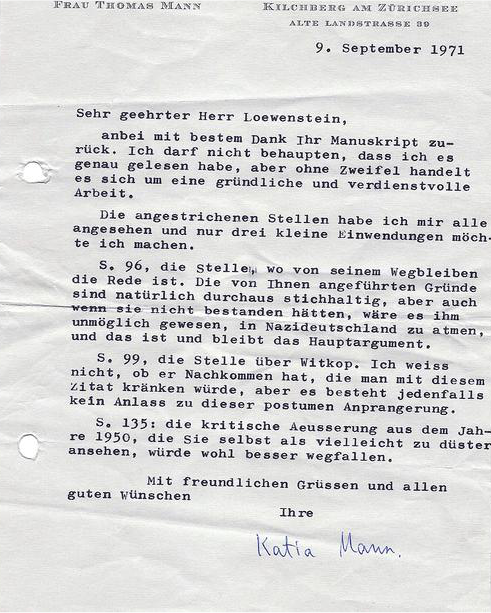
Transcription · German
Sehr geehrter Herr Loewenstein,
anbei mit bestem Dank Ihr Manuskript zurück. Ich darf nicht behaupten, dass ich es genau gelesen habe, aber ohne Zweifel handelt es sich um eine gründliche und verdienstvolle Arbeit.
Die angestrichenen Stellen habe ich mir alle angesehen und nur drei kleine Einwendungen möchte ich machen.
S. 96, die Stelle, wo von seinem Wegbleiben die Rede ist. Die von Ihnen angeführten Gründe sind natürlich durchaus stichhaltig, aber auch wenn sie nicht bestanden hätten, wäre es ihm unmöglich gewesen, in Nazideutschland zu atmen, und das ist und bleibt das Hauptargument.
S. 99, die Stelle über Witkop. Ich weiss nicht, ob er Nachkommen hat, die man mit diesem Zitat kränken würde, aber es besteht jedenfalls kein Anlass zu dieser postumen Anprangerung.
S. 135: die kritische Aeusserung aus dem Jahre 1950, die Sie selbst als vielleicht zu düster ansehen, würde wohl besser wegfallen.
Mit freundlichen Grüssen und allen guten Wünschen
Ihre
Katia Mann
Transcription · English
What she objected to
Dear Mr. Loewenstein,
Enclosed, with many thanks, is your manuscript. I cannot claim to have read it closely, but it is without doubt a thorough and worthwhile piece of work.
I have looked at all the marked passages, and I would raise only three small objections.
Page 96, the passage about his staying away. The reasons you give are of course entirely sound, but even had they not existed, it would have been impossible for him to breathe in Nazi Germany — and that is and remains the main argument.
Page 99, the passage about Witkop. I do not know whether he has descendants who would be hurt by this quotation, but in any case there is no occasion for this posthumous pillorying.
Page 135: the critical remark from 1950, which you yourself regard as perhaps too bleak, would be better left out.
With kind regards and every good wish,
Yours,
Katia Mann
English translation prepared for this archive. The German transcription above follows the letter as typed.
In the typescript
The three pages are marked
When every page of the scan was read and indexed, seven handwritten interventions came to light. Three of them fall on S. 96, S. 99 and S. 135 — the three pages, and only those three, that Katia Mann names in this letter.
On S. 99 a pair of pencil brackets encloses the phrase die Deutschen. On S. 135 the same kind of brackets enclose Breisacher und Fitelberg seien antisemitisch gestimmt, in the English quotation near the foot of the page. S. 96 carries pencil strokes through several typed words, too faint to read.
Her own wording invites care here. She writes that she looked at die angestrichenen Stellen — the marked passages — which means passages were already marked when the typescript reached her. Whose hand made which mark is not established, and the remaining four interventions sit elsewhere, at S. 324. What is certain is that the paper and the letter point at the same three pages.